
Landscape Lighting & Water Features in Lisle, Lombard & Winfield, IL: A 2026 Guide
Landscape Lighting & Water Features in Lisle, Lombard & Winfield, IL: A 2026 Guide
Two upgrades change how a backyard feels more than any amount of additional square footage: light and water. Landscape lighting doubles the hours you can use everything you've already built. A water feature adds sound and motion that turns a nice yard into a place you actually want to sit for an hour.
Both are also the two features homeowners most often skip during construction and regret later — because retrofitting wiring and plumbing under finished hardscape costs several times what it costs to install during the build. Here's what homeowners in Lisle, Lombard, and Winfield should know about landscape lighting and water features and ponds, from a Chicagoland contractor working here since 1984.
Part 1: Landscape Lighting
Why It's the Highest-Value Add-On in Chicagoland
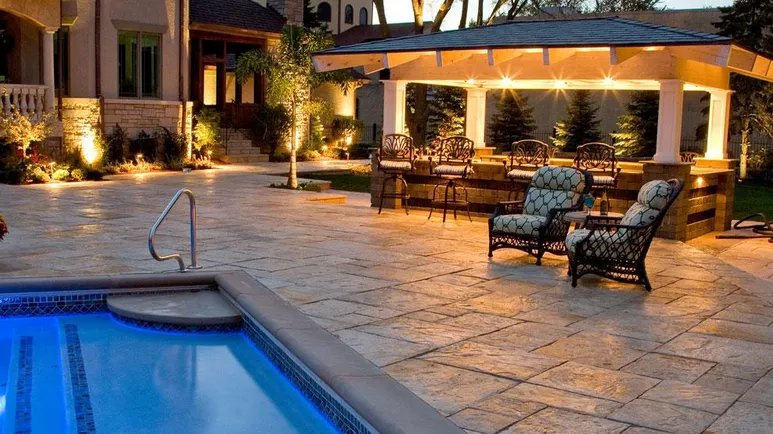
In our latitude, it's dark by 4:30 p.m. in December and before 8 p.m. by late August. Without lighting, an unlit patio is unusable for most of the evening hours during the majority of the year. With lighting, that same patio works after work, after dinner, and through fall.
Lighting also delivers three things beyond usable hours:
Safety. Steps, grade changes, and walkway edges are genuine hazards in the dark. Step lights and path lights are the cheapest liability reduction in your yard.
Security. Well-lit properties are less appealing targets, and layered landscape lighting looks far better than a single glaring floodlight.
Curb appeal at night. An uplit specimen tree and lit front entrance transform how a home reads from the street — a real advantage if you're listing.
Lighting Techniques That Actually Look Professional
The difference between a designed lighting plan and a row of solar stakes comes down to technique:
Uplighting — fixtures at the base of trees and architectural features, throwing light upward. The single most dramatic technique.
Downlighting / moonlighting — fixtures mounted high in trees, casting dappled light down through branches. Looks natural and lights broad areas without glare.
Path lighting — spaced to create overlapping pools of light, not the "runway" line of evenly spaced identical fixtures.
Step and wall lights — recessed into risers and retaining or seating walls so you see the light, not the fixture.
Grazing — light washed across stone or paver texture at a shallow angle to reveal depth. Beautiful on outdoor fireplaces and wall faces.
Silhouetting — lighting a wall behind a plant to render it as a shape.
The professional rule: light the object, hide the fixture.
What Landscape Lighting Costs
Professional low-voltage systems in this area generally run:
Starter system (8–12 fixtures): $2,500–$5,000
Full property (20–30 fixtures): $6,000–$14,000
Estate-scale systems: $15,000+
Pricing reflects fixture quality more than anything. Brass and copper fixtures with quality LED lamps last decades and develop a patina; inexpensive aluminum and plastic fixtures corrode in our winters and often need replacing within a few years. Given that labor is the same either way, fixture quality is where we recommend spending.
Modern systems are LED (roughly 80–90% less energy than old halogen setups), controlled by timers, photocells, or smartphone apps, and available in tunable color temperature and even color-changing options for holidays.
Part 2: Water Features & Ponds
Choosing the Right Type of Feature
Pondless waterfalls — water disappears into a hidden gravel reservoir instead of an open pool. The most popular option we install: all the sound and motion, no open water, minimal maintenance, and much easier around kids and pets. Typically $5,000–$15,000.
Bubbling rocks & urns — a compact, self-contained feature that fits in a front entrance bed, a courtyard, or beside a patio. $1,500–$5,000. The easiest entry point into water.
Koi and ecosystem ponds — a genuine hobby as much as a feature, with filtration, biological balance, and fish care. $10,000–$40,000+. Deeply rewarding for the right homeowner.
Spillways and sheer descents built into walls — water emerging from a retaining wall face or falling into a pool. Ideal on sloped Winfield and Lisle lots where you already have grade to work with. $3,000–$12,000+.
Why Water Features Work in Illinois — Even in Winter
The sound is the point. Moving water masks traffic noise from Butterfield Road, Route 53, or the tollway corridor in a way nothing else does, and it draws songbirds year-round. Pondless features can be shut down and drained for winter in an afternoon; ecosystem ponds can either run through winter with a de-icer and aerator or be shut down seasonally.
Placement Matters More Than Size
The most common mistake is putting a water feature at the far end of the yard where it's viewed but never heard. Features should be placed where you sit — beside the patio, near the outdoor kitchen bar, or visible and audible from the family room windows. A small feature ten feet from the seating area beats a large one forty feet away.
Why Both Should Be Designed Into the Project From Day One
Here's the practical argument for planning these during your hardscape build rather than after:
Conduit and plumbing get sleeved under hardscape while the base is open. Retrofitting under a finished paver patio or driveway means cutting into and resetting your surface.
Wall lights and pond spillways integrate into masonry, not onto it. Surface-mounted retrofits always look retrofitted.
Electrical capacity gets planned once, sized for the lighting, pump, and any future features.
You'll spend less overall — one mobilization, one excavation, one crew.
Even if you're phasing your project over several years, the infrastructure should go in during phase one. This is exactly what our 3D landscape design process is for: you see the night-time renderings and the water feature placement before we build anything.
Frequently Asked Questions
Do landscape lights raise my electric bill much? LED systems draw very little power — a full residential system typically costs a few dollars a month to run.
How much maintenance does a water feature need? Pondless features need occasional refilling, debris removal, and a seasonal shutdown. Ecosystem ponds require more regular attention and seasonal cleaning.
Will a water feature attract mosquitoes? Moving water doesn't support mosquito breeding — they need still water. A running feature is generally a non-issue.
Can you add lighting to an existing patio? Yes. Retrofits are common; we route wiring through landscape beds and along edges to minimize disruption, and in some cases lift and reset a small number of pavers.
Do these features survive Illinois winters? Yes, with proper design and seasonal shutdown. We build for freeze-thaw as a baseline requirement, not an afterthought.
Get a Free Lighting or Water Feature Quote
Both of these are best planned by walking your property and talking about how you actually use it after dark. Interlocking Pavers, Inc. has designed and built complete outdoor environments across DuPage County and Chicagoland since 1984.
Request your free lighting or water feature quote here or call 630-365-6386. We serve Lisle, Lombard, Winfield, and surrounding communities.