
Artificial Turf Installation in Plainfield, Oswego & Yorkville, IL: Costs, Pros & Cons (2026)
Artificial Turf Installation in Plainfield, Oswego & Yorkville, IL: Costs, Pros & Cons (2026)
If you live in one of the newer subdivisions spreading across Plainfield, Oswego, or Yorkville, you already know the story: the builder rolled sod over compacted clay, the yard drains poorly, the dog wore a path to the fence, and half the lawn is a mud pit from November to May. Artificial turf has become one of the fastest-growing requests we get from homeowners in this corridor — and for good reason. But it's also a product where installation quality determines everything.
Here's an honest look at artificial turf installation in the Kendall and Will County suburbs, from a hardscape contractor that's worked Chicagoland soil since 1984.
Why Turf Works So Well in Plainfield, Oswego & Yorkville
The Clay Soil Problem
Much of the new development in this area sits on heavy clay, and construction traffic compacts it further. Grass roots can't penetrate compacted clay, water doesn't infiltrate, and the result is a lawn that alternates between standing water and cracked dirt. Homeowners spend years — and thousands of dollars — on aeration, reseeding, and irrigation chasing a lawn that fights the soil beneath it.
Properly installed turf sits on an engineered aggregate base that drains better than the native soil. The mud problem doesn't get managed; it gets eliminated.
Dogs
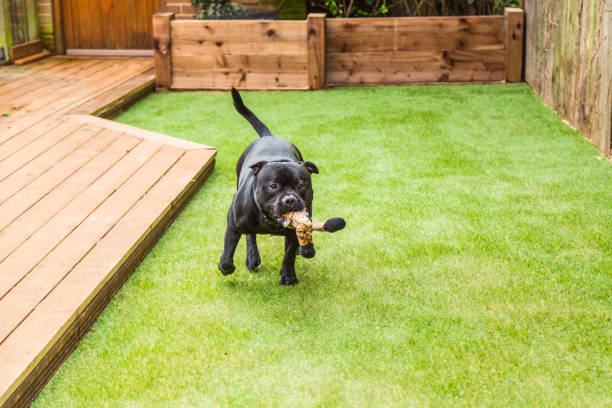
Pet owners are our single largest turf customer group. Turf ends the mud tracked across the kitchen floor, the worn dirt paths along fence lines, and the yellow urine spots. With the right pet-grade system — a permeable base, antimicrobial infill, and proper drainage — cleanup is a hose rinse.
Shade, Slopes & Problem Zones
Turf solves the areas where grass simply refuses to grow: deep shade on the north side of the house, steep slopes that scalp when mowed, narrow side yards, and the strip between a patio and a fence.
Water and Time
Kane, Kendall, and Will County water bills add up fast in July. Turf eliminates irrigation on the covered area, plus mowing, fertilizing, weed control, and reseeding. For many homeowners the maintenance savings alone pay back a meaningful share of the install over 8–12 years.
What Artificial Turf Costs in 2026
Professionally installed turf in the Plainfield/Oswego/Yorkville area typically runs $12–$20 per square foot, which covers excavation, base construction, turf material, infill, seaming, and edge securing.
Small pet run or side yard (300–500 sq ft): $3,600–$10,000
Backyard play area (800–1,200 sq ft): $9,600–$24,000
Full backyard conversion (2,000+ sq ft): $24,000+
Prices vary with turf grade (pile height, face weight, backing type), site prep difficulty, and how much demolition or grading is required first.
A word on cheap quotes: turf priced dramatically below this range almost always means a thin base, no proper compaction, or a low-face-weight product that mats down within a couple of seasons. Turf is a 15–25 year product when it's installed right and a 4-year product when it isn't.
What Proper Turf Installation Actually Requires
This is where hardscape experience matters — a turf install is fundamentally a base-building project with a green surface on top, which is exactly what we've been doing under pavers for four decades.
Removal of existing sod and excavation to the correct depth
Weed barrier and geotextile fabric over the clay subgrade
A compacted aggregate base, installed in lifts and compacted — this is what prevents the ripples, dips, and puddles you see in bad installs
Drainage integration — on flat Plainfield and Oswego lots, base drainage often needs to be tied into a broader plan; see our grading and drainage solutions
Turf laid with grain direction consistent, seams glued and stitched invisibly
Secured perimeter — nailed into base, or better, locked under a paver or wall border
Infill brushed in to weight the turf, support the blades, and (for pet systems) control odor
Designing Turf Into a Real Backyard — Not Just a Green Rectangle
The turf installs that look expensive share one trait: they're integrated with hardscape rather than dropped in isolation. Combinations we design frequently:
Paver bands through turf — parallel plank pavers with turf strips between, a modern look that's become extremely popular
Turf framed by a paver patio — the patio holds the furniture and grill, turf holds the kids and dogs, with a clean permanent border between
Turf around pools — no grass clippings tracking into the water; pairs naturally with a paver pool deck
Turf on terraces — for sloped Yorkville and Oswego lots, a retaining or seating wall creates a flat, usable turf terrace where there was an unusable hill
Putting greens — a genuine backyard upgrade, and one of the most-used features we install
Landscape lighting along turf borders and pathways for evening use
Because turf-and-hardscape layouts are hard to picture from a drawing, we model these in 3D landscape design before installation.
The Honest Downsides
Good advice includes the drawbacks:
Turf gets warm in direct summer sun — noticeably warmer than natural grass. Shaded areas and lighter infills help, and most families find it a non-issue outside peak afternoon heat.
Upfront cost is real. You're paying 15–25 years of lawn care in advance.
It's not zero maintenance. Expect occasional rinsing, leaf blowing, and periodic brushing to keep blades upright in high-traffic spots.
It's a permanent decision for that area of the yard.
Frequently Asked Questions
Does artificial turf drain in heavy rain? Yes — turf backing is perforated and sits over a permeable aggregate base. Correctly installed, it typically drains faster than a compacted clay lawn.
How does turf handle Illinois winters? Very well. Snow melts through and drains away. Turf doesn't go dormant, so it's green in April when neighboring lawns are still brown. Avoid metal shovels and rock salt on the surface.
Is it safe for kids and pets? Modern turf systems are made for exactly this use, and shock-absorbing pads can be added under play areas.
How long does installation take? Most residential turf projects take 2–5 days depending on size and site prep.
Will it look fake? Product grade decides this. Multi-tone blades with brown thatch layers and realistic pile heights read as natural from a few feet away — the shiny, uniform-green turf people picture is a decade out of date.
Get a Free Artificial Turf Quote
Every yard is different — soil, slope, drainage, and how you actually use the space all shape the right system. Interlocking Pavers, Inc. builds turf on the same engineered bases we've built paver driveways on since 1984, and consultations are free.
Request your free artificial turf quote here or call 630-365-6386. See our work near you in Plainfield, Oswego, and Yorkville.